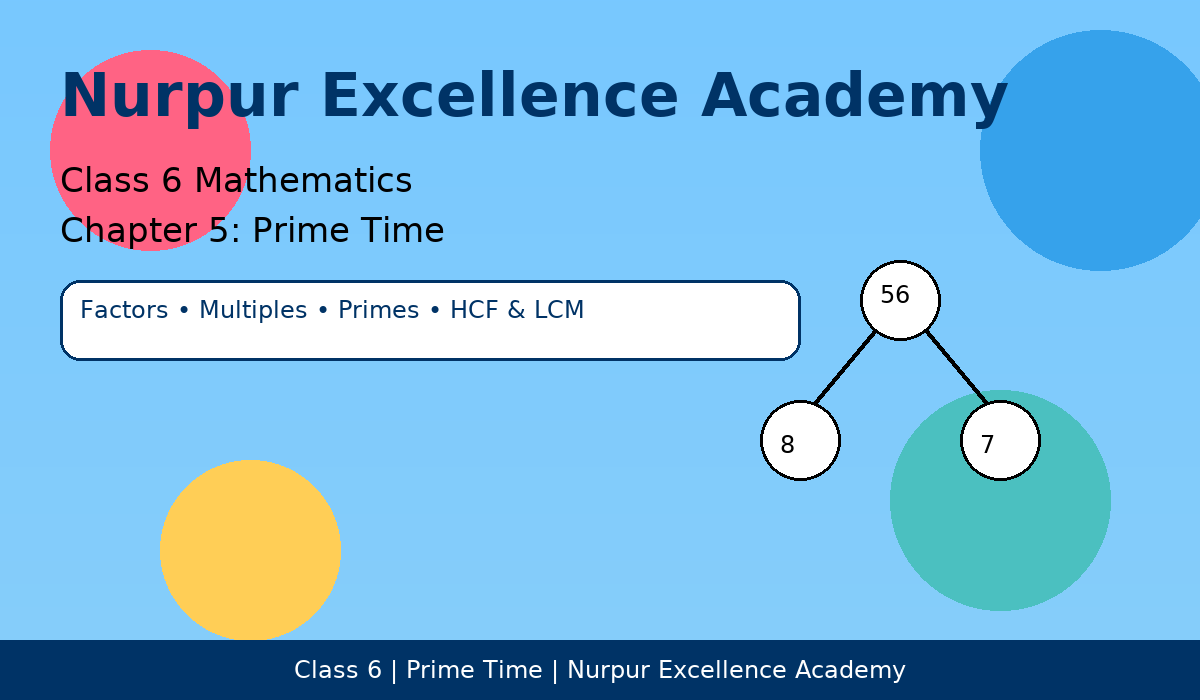
📘 Class 6 Mathematics – Chapter 5: Prime Time
✨ Complete Notes (All Topics Explained)
1. Factors
- Factors হল সেই সংখ্যা, যেগুলো কোনো সংখ্যা কে নিখুঁতভাবে ভাগ করতে পারে।
- Example: Factors of 12 → 1, 2, 3, 4, 6, 12
👉 Rules:
- 1 is a factor of every number.
- Every number is a factor of itself.
- Factors are always smaller than or equal to the number.
2. Multiples
- কোনো সংখ্যাকে 1, 2, 3… দ্বারা গুণ করলে যে সংখ্যাগুলো পাওয়া যায়, সেগুলোই Multiples।
- Example: Multiples of 5 → 5, 10, 15, 20, 25…
👉 Rules:
- Every number is a multiple of itself.
- Multiples are always greater than or equal to the number.
- Every multiple is infinite.
3. Prime Numbers
- Prime numbers এর কেবল দুটি factor থাকে → 1 এবং সংখ্যাটি নিজেই।
- Example: 2, 3, 5, 7, 11
👉 Important:
- 2 is the only even prime.
- Every other prime is odd.
- 1 is not prime.
4. Composite Numbers
- Composite numbers এর 2–এর বেশি factor থাকে।
- Example: 4 (factors = 1,2,4), 6 (1,2,3,6)
👉 Note: 1 is neither prime nor composite.
5. Co-prime Numbers
- দুটি সংখ্যা যদি 1 ছাড়া অন্য কোনো common factor না থাকে, তাহলে তারা co-prime।
- Example: 8 এবং 9 (Factors of 8 → 1,2,4,8; Factors of 9 → 1,3,9; Common factor = 1)
6. Prime Factorisation
- কোনো সংখ্যা কে শুধু prime সংখ্যাগুলোর গুণফল আকারে লেখা হলে সেটাই prime factorisation।
- Method → Factor Tree
- Example:
56 → 2 × 28 → 2 × (2 × 14) → 2 × (2 × (2 × 7))
✅ Answer: 56 = 2 × 2 × 2 × 7
7. HCF (Highest Common Factor)
- Common factors এর মধ্যে সবচেয়ে বড় সংখ্যাকে HCF বলে।
- Example: Factors of 18 → 1,2,3,6,9,18
Factors of 24 → 1,2,3,4,6,8,12,24
Common factors = 1,2,3,6 → HCF = 6
👉 Methods:
- By listing factors
- By prime factorisation
8. LCM (Lowest Common Multiple)
- Common multiples এর মধ্যে সবচেয়ে ছোট সংখ্যাকে LCM বলে।
- Example: Multiples of 6 → 6,12,18,24…
Multiples of 8 → 8,16,24,32…
✅ LCM = 24
👉 Methods:
- By listing multiples
- By prime factorisation
9. Divisibility Rules
| Number | Rule | Example |
|---|---|---|
| 2 | Last digit even | 246 ✔ |
| 3 | Sum of digits multiple of 3 | 153 ✔ |
| 4 | Last 2 digits divisible by 4 | 524 ✔ |
| 5 | Last digit 0 or 5 | 425 ✔ |
| 6 | Divisible by both 2 and 3 | 132 ✔ |
| 7 | Double last digit, subtract from rest → result divisible by 7 | 532 → 53–4=49 ✔ |
| 8 | Last 3 digits divisible by 8 | 5160 → 160÷8=20 ✔ |
| 9 | Sum of digits multiple of 9 | 234 ✔ |
| 10 | Last digit 0 | 560 ✔ |
10. Tests for Prime Numbers
👉 To check if a number is prime:
- Divide it by prime numbers less than or equal to its square root.
- Example: Check 97 → √97 ≈ 10 → test by 2,3,5,7 → not divisible → Prime.
11. Difference Between Factors and Multiples
| Factors | Multiples |
|---|---|
| Limited in number | Infinite in number |
| Smaller or equal to the number | Greater or equal to the number |
| Example: Factors of 12 = 1,2,3,4,6,12 | Multiples of 12 = 12,24,36,48,… |
12. Sieve of Eratosthenes (Finding Primes)
- Write numbers from 2 to 100.
- Circle 2 and cross out all its multiples.
- Next uncrossed number (3) → circle it, cross out its multiples.
- Continue with 5, 7, 11, … up to √100.
- Remaining uncrossed numbers are primes.
13. Important Points to Remember
- 1 is neither prime nor composite.
- 2 is the only even prime.
- HCF is always a factor, LCM is always a multiple.
- Two consecutive numbers are always co-prime.
- Every composite number can be expressed as a product of primes.
✨ MCQ Worksheet (25 Questions with Answers)
✅ Multiple Choice Questions (1–25)
Q1. Which is a prime number?
a) 9 b) 11 c) 15 d) 21
👉 Answer: 11 (Factors are only 1 and 11)
Q2. Smallest prime number is –
a) 0 b) 1 c) 2 d) 3
👉 Answer: 2
Q3. Largest prime between 10 and 20 –
a) 17 b) 19 c) 13 d) 11
👉 Answer: 19
Q4. Which is a composite number?
a) 2 b) 3 c) 4 d) 5
👉 Answer: 4 (factors 1,2,4)
Q5. LCM of 4 and 6 =
a) 8 b) 10 c) 12 d) 18
👉 Answer: 12
Q6. HCF of 12 and 18 =
a) 2 b) 4 c) 6 d) 12
👉 Answer: 6
Q7. Co-prime pair is –
a) 12 & 18 b) 9 & 25 c) 14 & 21 d) 20 & 30
👉 Answer: 9 & 25
Q8. Prime factorisation of 30 =
a) 2×3×5 b) 2×15 c) 3×10 d) 5×6
👉 Answer: 2×3×5
Q9. Which number is divisible by 9?
a) 145 b) 279 c) 235 d) 452
👉 Answer: 279 (2+7+9=18, divisible by 9)
Q10. Only even prime number –
a) 1 b) 2 c) 3 d) 4
👉 Answer: 2
Q11. 1 is –
a) Prime b) Composite c) Neither d) Both
👉 Answer: Neither
Q12. LCM of 8 and 12 =
a) 12 b) 24 c) 36 d) 48
👉 Answer: 24
Q13. Prime factors of 84 –
a) 2×2×3×7 b) 2×3×14 c) 3×28 d) 2×42
👉 Answer: 2×2×3×7
Q14. Factors of 45 –
a) 1, 3, 5, 9, 15, 45
b) 1, 2, 3, 6, 9, 18
c) 1, 3, 15, 45
d) 1, 5, 9, 45
👉 Answer: a)
Q15. Which is NOT a prime number?
a) 29 b) 31 c) 33 d) 37
👉 Answer: 33
Q16. LCM of 5 and 15 =
a) 15 b) 30 c) 45 d) 60
👉 Answer: 15
Q17. HCF of 20 and 28 =
a) 2 b) 4 c) 6 d) 8
👉 Answer: 4
Q18. Prime number between 50 and 60 is –
a) 51 b) 53 c) 55 d) 57
👉 Answer: 53
Q19. Which of these is divisible by 11?
a) 231 b) 245 c) 319 d) 451
👉 Answer: 231 (alternating sum 2–3+1=0)
Q20. Which is the smallest composite number?
a) 1 b) 2 c) 3 d) 4
👉 Answer: 4
Q21. Prime factors of 100 =
a) 2×2×5×5 b) 10×10 c) 4×25 d) 20×5
👉 Answer: 2×2×5×5
Q22. Which of these is NOT a co-prime pair?
a) 8 & 9 b) 14 & 15 c) 21 & 22 d) 12 & 20
👉 Answer: 12 & 20 (common factor 4)
Q23. 2-digit largest prime number is –
a) 97 b) 99 c) 89 d) 91
👉 Answer: 97
Q24. LCM of 9 and 12 =
a) 18 b) 24 c) 36 d) 48
👉 Answer: 36
Q25. Which of the following is divisible by 8?
a) 124 b) 256 c) 342 d) 516
👉 Answer: 256 (last three digits 256÷8=32)
✨ True / False Worksheet (25 Questions with Answers)
✅ True / False Questions (1–25)
Q1. 1 is a prime number.
👉 False (It has only one factor)
Q2. 2 is the only even prime number.
👉 True
Q3. Every multiple of 5 ends with 0 or 5.
👉 True
Q4. 49 is a prime number.
👉 False (49 = 7×7)
Q5. Prime factorisation of 100 = 2×2×5×5.
👉 True
Q6. Factors of 18 are 1, 2, 3, 6, 9, 18.
👉 True
Q7. 15 and 28 are co-prime numbers.
👉 True (HCF = 1)
Q8. Every even number greater than 2 is composite.
👉 True
Q9. 3 divides 153 exactly.
👉 True (1+5+3=9, divisible by 3)
Q10. HCF of 8 and 12 is 6.
👉 False (Correct HCF = 4)
Q11. LCM of 6 and 9 is 18.
👉 True
Q12. Every prime is an odd number.
👉 False (2 is an even prime)
Q13. 91 is divisible by 7.
👉 True (7×13=91)
Q14. 125 ends with 5, so divisible by 5.
👉 True
Q15. All composite numbers have more than 2 factors.
👉 True
Q16. 57 is a prime number.
👉 False (57=3×19)
Q17. The smallest composite number is 4.
👉 True
Q18. Multiples of 9 always have a digit sum divisible by 9.
👉 True
Q19. 221 is a prime number.
👉 False (221=13×17)
Q20. 2, 3, 5, 7 are the first four prime numbers.
👉 True
Q21. The number 0 is a multiple of every number.
👉 True
Q22. 81 is divisible by 9.
👉 True (8+1=9)
Q23. 143 is a prime number.
👉 False (143=11×13)
Q24. Every factor of a number is smaller than or equal to the number itself.
👉 True
Q25. Prime factorisation of 36 is 2×2×3×3.
👉 True
✨ Fill in the Blanks Worksheet (25 Questions with Answers)
✅ Fill in the Blanks (1–25)
Q1. Factors of 24 = __________.
👉 Answer: 1, 2, 3, 4, 6, 8, 12, 24
Q2. The smallest prime number is __________.
👉 Answer: 2
Q3. 1 is neither __________ nor __________.
👉 Answer: Prime, Composite
Q4. Multiples of 7 = __________.
👉 Answer: 7, 14, 21, 28, 35 …
Q5. Prime factorisation of 84 = __________.
👉 Answer: 2 × 2 × 3 × 7
Q6. LCM of 5 and 10 = __________.
👉 Answer: 10
Q7. HCF of 12 and 18 = __________.
👉 Answer: 6
Q8. Numbers with only two factors are called __________.
👉 Answer: Prime Numbers
Q9. 2, 3, 5, 7 are __________ numbers.
👉 Answer: Prime
Q10. The sum of digits of 432 is divisible by __________.
👉 Answer: 3 and 9
Q11. Prime factorisation of 36 = __________.
👉 Answer: 2 × 2 × 3 × 3
Q12. Multiples of 9 up to 45 = __________.
👉 Answer: 9, 18, 27, 36, 45
Q13. 2 is the only __________ prime number.
👉 Answer: Even
Q14. 49 is divisible by __________.
👉 Answer: 7
Q15. Numbers like 8 and 9, having only 1 as a common factor, are called __________.
👉 Answer: Co-prime
Q16. The greatest factor of any number is __________.
👉 Answer: The number itself
Q17. The smallest factor of any number is always __________.
👉 Answer: 1
Q18. Prime factorisation of 60 = __________.
👉 Answer: 2 × 2 × 3 × 5
Q19. The LCM of 6 and 8 is __________.
👉 Answer: 24
Q20. The HCF of 16 and 24 is __________.
👉 Answer: 8
Q21. Every multiple of 10 ends with __________.
👉 Answer: 0
Q22. The product of two prime numbers is always a __________ number.
👉 Answer: Composite
Q23. 91 is divisible by __________.
👉 Answer: 7 and 13
Q24. 15 and 28 are __________ numbers.
👉 Answer: Co-prime
Q25. Prime factorisation of 100 = __________.
👉 Answer: 2 × 2 × 5 × 5
✨ Short Answer Worksheet (25 Questions with Step-by-step Answers)
✅ Short Questions with Explained Answers (1–25)
Q1. Find all prime numbers between 10 and 20.
👉 Numbers: 11, 12, 13, 14, 15, 16, 17, 18, 19
- 11 → Prime
- 12,14,15,16,18 → Composite
- 13,17,19 → Prime
✅ Answer: 11, 13, 17, 19
Q2. Write prime factorisation of 90.
- 90 ÷ 2 = 45
- 45 ÷ 3 = 15
- 15 ÷ 3 = 5
- 5 ÷ 5 = 1
✅ Answer: 90 = 2 × 3 × 3 × 5
Q3. Find the smallest number divisible by both 4 and 6.
- This means LCM(4,6)
- 4 = 2 × 2
- 6 = 2 × 3
- LCM = 2 × 2 × 3 = 12
✅ Answer: 12
Q4. Write first 6 multiples of 8.
👉 8 × 1=8, 8×2=16, 8×3=24, 8×4=32, 8×5=40, 8×6=48
✅ Answer: 8, 16, 24, 32, 40, 48
Q5. Find HCF of 24 and 36 by prime factorisation.
- 24 = 2 × 2 × 2 × 3
- 36 = 2 × 2 × 3 × 3
- Common factors = 2 × 2 × 3 = 12
✅ Answer: HCF = 12
Q6. Find LCM of 9 and 12 by prime factorisation.
- 9 = 3 × 3
- 12 = 2 × 2 × 3
- LCM = 2 × 2 × 3 × 3 = 36
✅ Answer: 36
Q7. Are 35 and 64 co-prime?
- 35 = 5 × 7
- 64 = 2 × 2 × 2 × 2 × 2 × 2
- No common factors except 1
✅ Answer: Yes, 35 and 64 are co-prime
Q8. Write all factors of 45.
- Divisors of 45: 1, 3, 5, 9, 15, 45
✅ Answer: 1, 3, 5, 9, 15, 45
Q9. Test divisibility of 252 by 2, 3, 5.
- By 2 → last digit 2 → Yes
- By 3 → sum = 2+5+2=9 → Yes
- By 5 → last digit not 0 or 5 → No
✅ Answer: Divisible by 2 and 3 only
Q10. Write all primes less than 20.
👉 2, 3, 5, 7, 11, 13, 17, 19
✅ Answer: 2, 3, 5, 7, 11, 13, 17, 19
Q11. Write first 5 multiples of 12.
👉 12, 24, 36, 48, 60
✅ Answer: 12, 24, 36, 48, 60
Q12. Write prime factorisation of 120.
- 120 ÷ 2 = 60
- 60 ÷ 2 = 30
- 30 ÷ 2 = 15
- 15 ÷ 3 = 5
- 5 ÷ 5 = 1
✅ Answer: 120 = 2 × 2 × 2 × 3 × 5
Q13. Is 525 divisible by 9?
- Sum of digits = 5+2+5=12
- 12 not divisible by 9
✅ Answer: No
Q14. Find LCM of 8 and 12.
- 8 = 2 × 2 × 2
- 12 = 2 × 2 × 3
- LCM = 2 × 2 × 2 × 3 = 24
✅ Answer: 24
Q15. Find HCF of 15 and 25.
- 15 = 3 × 5
- 25 = 5 × 5
- Common = 5
✅ Answer: HCF = 5
Q16. Write first 5 multiples of 7.
👉 7, 14, 21, 28, 35
✅ Answer: 7, 14, 21, 28, 35
Q17. Write prime factorisation of 150.
- 150 ÷ 2 = 75
- 75 ÷ 3 = 25
- 25 ÷ 5 = 5
- 5 ÷ 5 = 1
✅ Answer: 150 = 2 × 3 × 5 × 5
Q18. Find HCF of 20 and 28.
- 20 = 2 × 2 × 5
- 28 = 2 × 2 × 7
- Common = 2 × 2 = 4
✅ Answer: 4
Q19. Find LCM of 15 and 20.
- 15 = 3 × 5
- 20 = 2 × 2 × 5
- LCM = 2 × 2 × 3 × 5 = 60
✅ Answer: 60
Q20. Write all prime factors of 210.
- 210 = 2 × 3 × 5 × 7
✅ Answer: 2, 3, 5, 7
Q21. Check divisibility of 846 by 2, 3, 5, 9.
- By 2 → last digit 6 → Yes
- By 3 → sum=18 → Yes
- By 5 → last digit not 0/5 → No
- By 9 → 18 divisible by 9 → Yes
✅ Answer: Divisible by 2, 3, 9
Q22. Find smallest prime factor of 91.
- 91 ÷ 7 = 13
✅ Answer: 7
Q23. Write first 10 multiples of 6.
👉 6, 12, 18, 24, 30, 36, 42, 48, 54, 60
✅ Answer: 6, 12, 18, 24, 30, 36, 42, 48, 54, 60
Q24. Write all prime numbers between 30 and 50.
👉 31, 37, 41, 43, 47
✅ Answer: 31, 37, 41, 43, 47
Q25. Find HCF of 32 and 48.
- 32 = 2^5
- 48 = 2^4 × 3
- Common = 2^4 = 16
✅ Answer: 16
✨ Long Answer Worksheet (25 Questions with Step-by-step Solutions)
✅ Long Questions with Explained Answers (1–25)
Q1. Explain prime, composite and co-prime numbers with examples.
👉
- Prime numbers → only 2 factors (e.g., 2, 3, 5).
- Composite numbers → more than 2 factors (e.g., 4=2×2, 6=2×3).
- Co-prime numbers → HCF = 1 (e.g., 8 and 9).
Q2. Find HCF and LCM of 18 and 24 using prime factorisation.
- 18 = 2 × 3 × 3
- 24 = 2 × 2 × 2 × 3
- HCF → common lowest powers = 2 × 3 = 6
- LCM → all highest powers = 2×2×2×3×3 = 72
✅ Answer: HCF = 6, LCM = 72
Q3. Explain divisibility rules of 2, 3, 4, 5, 6, 9, 10.
👉
- 2 → last digit even
- 3 → sum of digits multiple of 3
- 4 → last 2 digits divisible by 4
- 5 → last digit 0 or 5
- 6 → divisible by 2 and 3
- 9 → sum of digits multiple of 9
- 10 → last digit 0
Q4. Use factor tree to find prime factors of 120.
- 120 = 12 × 10
- 12 = 3 × 4 = 3 × (2 × 2)
- 10 = 2 × 5
✅ Prime factors: 120 = 2 × 2 × 2 × 3 × 5
Q5. Check divisibility of 735 by 2, 3, 5, 7, 9, 11.
- By 2 → last digit 5 → No
- By 3 → sum=15 → Yes
- By 5 → last digit 5 → Yes
- By 7 → 73–(2×5)=63 → divisible → Yes
- By 9 → 15 not divisible → No
- By 11 → (7–3+5)=9 → No
✅ Answer: Divisible by 3, 5, 7
Q6. Find smallest number divisible by 15, 20 and 25.
- Prime factors:
- 15=3×5
- 20=2^2×5
- 25=5^2
- LCM = 2^2 × 3 × 5^2 = 300
✅ Answer: 300
Q7. Write first 10 multiples of 12 and find common multiples with 8.
- Multiples of 12: 12,24,36,48,60,72,84,96,108,120
- Multiples of 8: 8,16,24,32,40,48,56,64,72,80,88,96
- Common: 24,48,72,96
✅ Answer: 24, 48, 72, 96
Q8. Find HCF of 20, 28 and 36.
- 20=2×2×5
- 28=2×2×7
- 36=2×2×3×3
- Common = 2×2=4
✅ Answer: 4
Q9. Find LCM of 8, 9 and 12.
- 8=2^3
- 9=3^2
- 12=2^2×3
- LCM = 2^3 × 3^2 = 72
✅ Answer: 72
Q10. Prove that 97 is a prime number.
- Check divisibility by primes ≤ √97≈10 (2,3,5,7).
- 97 not divisible by 2,3,5,7.
✅ Answer: 97 is prime
Q11. Explain why 1 is neither prime nor composite.
- Prime → needs 2 factors.
- Composite → needs more than 2 factors.
- 1 has only 1 factor (itself).
✅ Answer: Neither prime nor composite
Q12. Show that product of two prime numbers is always composite.
- Example: 2×3=6 (factors: 1,2,3,6)
- More than 2 factors → composite.
✅ Answer: True
Q13. Find prime factors of 210.
- 210 ÷ 2 = 105
- 105 ÷ 3 = 35
- 35 ÷ 5 = 7
- 7 ÷ 7 = 1
✅ Answer: 210 = 2 × 3 × 5 × 7
Q14. Show that 13 × 17 is composite.
- 13 and 17 are prime
- Their product = 221
- 221 has factors 1,13,17,221 → composite
✅ Answer: 221 is composite
Q15. Explain difference between factors and multiples with examples.
- Factors → divide number exactly (12 → 1,2,3,4,6,12)
- Multiples → results of multiplication (12 → 12,24,36,48,…)
Q16. Write all prime numbers between 30 and 50.
- 31, 37, 41, 43, 47
✅ Answer: 31, 37, 41, 43, 47
Q17. Find LCM of 18, 24 and 30.
- 18=2×3^2
- 24=2^3×3
- 30=2×3×5
- LCM = 2^3 × 3^2 × 5 = 360
✅ Answer: 360
Q18. Find HCF of 48 and 60.
- 48=2^4×3
- 60=2^2×3×5
- HCF = 2^2×3 = 12
✅ Answer: 12
Q19. Check divisibility of 1001 by 7, 11 and 13.
- 1001 ÷ 7 = 143
- 143 ÷ 11 = 13
✅ Answer: 1001 = 7 × 11 × 13
Q20. Write first 15 multiples of 5.
👉 5,10,15,20,25,30,35,40,45,50,55,60,65,70,75
Q21. Find prime factorisation of 96 using factor tree.
- 96=2×48
- 48=2×24
- 24=2×12
- 12=2×6
- 6=2×3
✅ Answer: 96=2^5×3
Q22. Explain Sieve of Eratosthenes method of finding primes up to 100.
- Write numbers 2 to 100
- Circle 2, cross multiples
- Next uncrossed (3) → circle, cross multiples
- Continue with 5,7,11… up to √100
- Remaining uncrossed = primes
Q23. Find LCM of 14, 21 and 36.
- 14=2×7
- 21=3×7
- 36=2^2×3^2
- LCM=2^2×3^2×7=252
✅ Answer: 252
Q24. Find HCF of 63, 84 and 105.
- 63=3^2×7
- 84=2^2×3×7
- 105=3×5×7
- Common=3×7=21
✅ Answer: 21
Q25. Write first 20 prime numbers.
👉 2,3,5,7,11,13,17,19,23,29,31,37,41,43,47,53,59,61,67,71



Leave a Reply