Explore what Teaching Learning Material (TLM) means, its types, examples, and importance in education. Discover how charts, models, and digital tools make learning fun and interactive for students of all levels.
🌟
Teaching Learning Material (TLM) plays a vital role in making education engaging, meaningful, and effective.
It includes all the tools, models, charts, and digital aids that help teachers explain lessons better and students understand more deeply.
From 🎨 colorful flashcards to 🧠 virtual labs and AR simulations — TLM bridges the gap between theory and practice, turning every classroom into an exciting place for discovery.
🎓 What is TLM (Teaching Learning Material)?
TLM stands for Teaching Learning Material — any resource or object that assists teachers in explaining concepts and students in learning them effectively. It can be physical (like charts, models, or storybooks) or digital (like videos, simulations, or apps).
🎯 Main Goal: To make learning interactive, visual, and long-lasting through participation and creativity.
🎨 Types of TLM (Teaching Learning Materials)
🖼️ 1. Charts & Posters
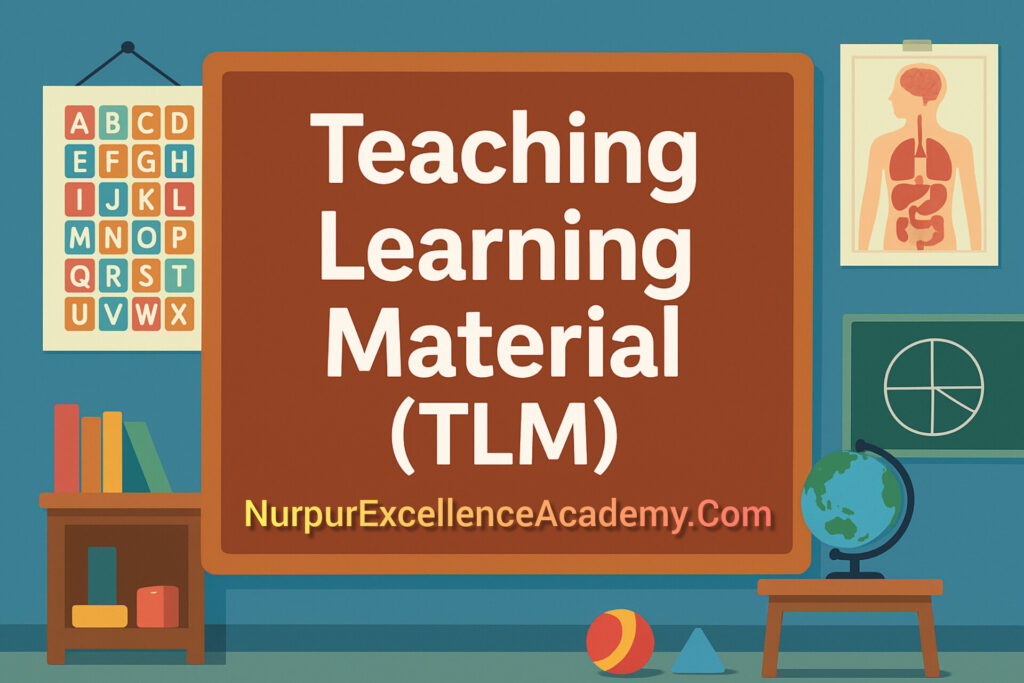
Alphabet charts, multiplication tables, science diagrams (plant, human body).
🔹 Benefit: Builds visual understanding and supports memory.
🃏 2. Flashcards
Vocabulary, math facts, historical dates.
🔹 Benefit: Encourages active recall and quick learning.
🧩 3. Models
Solar system, plant/animal cell, geometric shapes.
🔹 Benefit: Makes concepts real with 3D visualization.
🧠 4. Diagrams & Drawings
Flowcharts, life cycles, and process diagrams.
🔹 Benefit: Simplifies complex ideas visually.
📄 5. Worksheets & Activity Sheets
Practice exercises, puzzles, matching games.
🔹 Benefit: Strengthens understanding through repetition.
📚 6. Storybooks & Picture Books
Used for storytelling, reading comprehension, and imagination.
🔹 Benefit: Improves language skills and creativity.
🎬 7. Audio-Visual Aids
Educational videos, animations, and slideshows.
🔹 Benefit: Engages multiple senses and boosts focus.
💻 8. Interactive Tools
Smartboard activities, educational apps, online quizzes.
🔹 Benefit: Makes lessons engaging and participatory.
🍎 9. Real Objects
Fruits, leaves, coins, small lab instruments.
🔹 Benefit: Connects classroom learning with real-life examples.
🎭 10. Games & Role Play Materials
Board games, role-play cards, puppets.
🔹 Benefit: Builds teamwork, confidence, and communication.
🔬 11. Laboratory Equipment
Microscope, beakers, test tubes, magnet sets.
🔹 Benefit: Encourages experimentation and inquiry.
🗺️ 12. Maps & Globes
World maps, political maps, globes.
🔹 Benefit: Enhances geographical knowledge and spatial understanding.
⏰ 13. Charts with Movable Parts
Clock with movable hands, anatomy charts with flaps.
🔹 Benefit: Promotes hands-on, kinesthetic learning.
🧑💻 14. Digital Learning Tools
Simulation software, coding kits, virtual lab apps.
🔹 Benefit: Fosters curiosity and digital skills.
🎨 15. Project-based Materials
Science fair kits, model-making sets, craft supplies.
🔹 Benefit: Develops creativity and teamwork.
📋 16. Assessment Materials
Rubrics, checklists, self-assessment sheets.
🔹 Benefit: Helps track learning progress.
🗣️ 17. Language Learning Aids
Pronunciation cards, sentence kits, audio lessons.
🔹 Benefit: Improves speaking and comprehension.
🔢 18. Mathematics Manipulatives
Abacus, number rods, fraction blocks, geometric solids.
🔹 Benefit: Makes math learning playful and visual.
🏫 TLM by School Level (Class-wise Breakdown)
🎈 Primary Level (Class 1–5)
- 🖼️ Visual Aids: Charts, posters, flashcards, storybooks, picture books
- 🧸 Hands-on Materials: Blocks, toys, simple science kits, fruits/leaves
- 🎵 Audio-Visual: Educational videos, rhymes, songs
- 🧩 Interactive: Role play, puzzles, matching games
🟢 Focus: Building curiosity, imagination, and basic understanding.
🧮 Middle Level (Class 6–8)
- 🧬 Science & Math Models: Plant/animal cell models, geometric solids
- 🗺️ Maps & Globes: Political maps, physical maps, globes
- 📊 Charts & Diagrams: Life cycles, periodic table, flowcharts
- 💻 Digital Tools: Simulations, educational apps
- 🧠 Worksheets & Activities: Project-based tasks, experiments
🟢 Focus: Enhancing observation and concept clarity through exploration.
🧪 Secondary Level (Class 9–10)
- 🔬 Laboratory Equipment: Microscope, magnet sets, chemistry kits
- ⚙️ Advanced Models: Solar system, anatomy, physics apparatus
- 💡 Digital Tools: Virtual labs, coding apps, simulations
- 📋 Assessment Materials: Rubrics, self-evaluation sheets
- 🧰 Project Materials: Science fair models, craft kits
🟢 Focus: Promoting analytical skills and real-world application.
🎓 Higher Secondary Level (Class 11–12)
- 🧫 Specialized Lab Equipment: Advanced microscopes, electrical kits, apparatus
- 💻 Simulation & Software: Physics simulations, math tools, chemistry software
- 🧩 Project-based Learning: Research, mini-STEM projects
- 📊 Advanced Visuals: Graphs, 3D models, detailed diagrams
- 🌐 Digital Learning: VR/AR experiments, online simulations
🟢 Focus: Deep learning, innovation, and scientific reasoning.
💡 Importance of TLM in Education
✅ Makes learning fun and interactive
✅ Simplifies difficult concepts
✅ Promotes active participation
✅ Supports different learning styles (visual, auditory, kinesthetic)
✅ Builds creativity, critical thinking, and teamwork
✅ Bridges the gap between theory and practice
⚡ Modern Digital TLM
With technology, classrooms have become smart learning spaces 🌐.
Modern TLM now includes:
- 💻 Smartboards & Interactive Whiteboards
- 🎧 Audio-visual learning content
- 🧠 AR/VR-based experiences
- 📱 Educational apps & e-learning tools
- 🧪 Virtual labs and digital simulations
These tools make learning more dynamic, personalized, and engaging.
🏁
Teaching Learning Material (TLM) is the heart of effective education.
Whether it’s a simple alphabet chart or a virtual science lab, every TLM helps students see, feel, and experience what they learn.
🎯 A school that uses TLM effectively creates a joyful, creative, and impactful learning environment — where knowledge is not just taught but truly experienced.


Leave a Reply